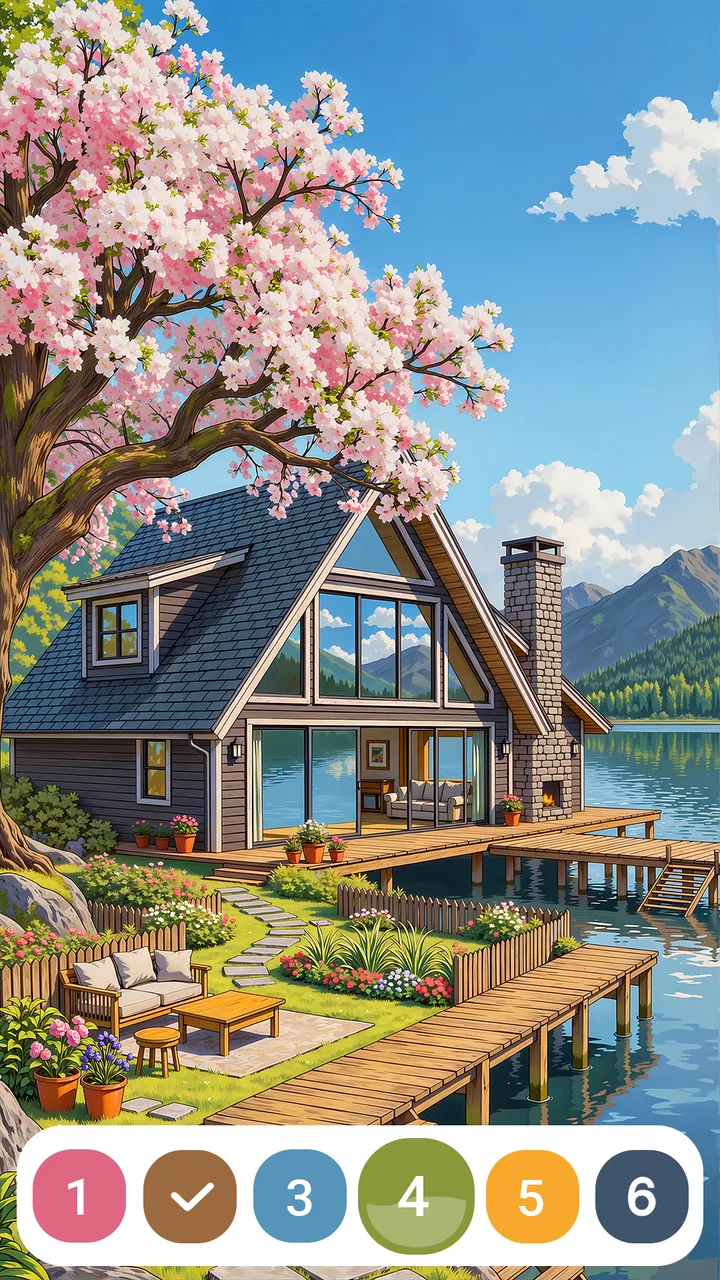
Lakeside House Paint by Number
- 4.6
- Rating
- 100.00K
- Installs
- Free
- Price

 Analysis by App-foxy
I opened Lakeside House Paint by Number expecting a quiet coloring game, and that is exactly where it works best: as a gentle break rather than a demanding challenge. The game focuses on lakeside homes, cabins, cottages, and similar retreats, with each picture divided into numbered areas that gradually become a finished scene. I found the appeal less in speed or competition and more in the small satisfaction of turning a mostly blank illustration into something warm and complete.
It is a free board game from BrainArt Studio, rated for Everyone, and its simple premise makes it approachable for children, adults, and anyone who enjoys relaxing creative tasks. The store shows a 4.6 average from over 600 ratings, while the game has passed 100K installs. Those figures suggest that the idea has found a receptive audience, but the more important question is whether its pace suits you. In my experience, it does if you want calm, low-pressure play. It is a weaker fit if you need strategy, competition, or constant novelty.
What to expect from the lakeside coloring experience
The central routine is easy to understand. You choose a lakeside illustration, look for an area marked with a number, select the matching color, and fill that section. Repeating that process slowly brings the house and its surroundings into focus. The subject matter gives the game a consistent mood: wooden homes, water, outdoor scenery, and cozy retreats create a softer atmosphere than the bright, frantic presentation found in many casual games.
You May Also Like

 Blood Strike: 2.5 Anniversary
Blood Strike’s Loadouts Turn Every Drop Into a Tactical Gamble
A close look at Blood Strike’s custom loadouts: how fast access to signature weapons reshapes its battle royale rhythm, rewards preparation, and narrows the gap between fights.

 Pandora - Music & Podcasts
Pandora’s Music Is Easy to Start, but Harder to Recover
Pandora’s strength is its low-effort path from a seed to a station. Its weak spot is how much confidence it asks you to place in connection, setup, and quiet recovery.

 8 Ball Pool
 Is Built on Rivalries, Rematches, and Routine
A close look at the rivalries, rematches, shared routines, and unanswered safety questions that turn a quick pool match into a persistent mobile community.

 Samsung Music
’s Quiet Strength Is Playing What You Already Own
Its reach comes less from spectacle than from dependable access to a personal library. That simplicity is both the app’s strongest retention engine and its ceiling.

 AccuWeather: Weather Radar
AccuWeather Review: A Quick, Clear Forecast for Everyday Decisions
For everyday plans, the best forecast is the one you can understand quickly. AccuWeather makes rain timing, radar, and local conditions easy to act on, with a few trade-offs.

 Hill Climb Racing
Why Hill Climb Racing Still Turns Crashes Into One More Run
A tiny car, a bumpy hill and one more upgrade: Hill Climb Racing keeps resurfacing because its simple chaos makes every near-miss feel personal.
More From Our News Desk



That simplicity is both the main strength and the main limitation. There is no complicated rulebook to learn before you can begin, and a first-time player can understand the basic action almost immediately. At the same time, the game is not designed to test planning or memory in the way a traditional board game might. Calling it a board game describes its store category, but I would approach it as a digital paint-by-number activity with a board-like selection of scenes.
I also appreciated that the subject matter gives the coloring a recognizable sense of place. A cabin beside a lake feels different from a generic abstract pattern, because each completed section contributes to a small visual setting. That makes progress easier to notice. Instead of merely filling isolated shapes, I felt I was restoring a whole retreat one detail at a time.
The best time to use it is when your attention is available but your energy is low. I can imagine opening it after work, completing a few areas while sitting with a cup of tea, and stopping before the activity starts to feel repetitive. It also suits a short wait, although players who want a clearly defined five-minute challenge may find that the natural stopping point depends on the picture rather than on a fixed session structure.
How I approached the first setup
The game is free to start, which removes the biggest barrier for a curious first-time player. I would install it with the expectation that optional purchases may appear during use, because in-app items range from $0.99 to $39.99 each. That does not make the game unsuitable, but it does make a little attention worthwhile. I prefer to decide in advance whether I am happy to stay entirely within the free experience or whether I might spend on an occasional convenience.
The current version is 1.1.0 and it runs on Android 7.0 or later. For someone using an older phone or tablet, checking the operating system before trying to install saves an unnecessary search. On a compatible device, the important first step is not technical at all: choose a quiet moment and resist the urge to judge the game by its opening image alone. The pleasure comes from the gradual change as small numbered spaces disappear.
I recommend beginning with a scene that looks visually manageable rather than choosing the most detailed image immediately. A picture with larger, clearly separated areas gives you a faster understanding of the interaction. Once the matching-number process feels natural, a more intricate cottage or lakeside home becomes less intimidating because you already know how to navigate the work.
Before starting, I would also set a personal boundary around purchases. The game’s free entry is useful for testing whether the coloring rhythm suits you, and there is no reason to spend before you know that. If you later decide that the experience is worth supporting, make that a deliberate choice rather than treating an in-game prompt as part of the coloring task.
The first meaningful success
My advice for the first session is to aim for one clearly recognizable part of the picture, such as a section of the house or a prominent area near the water. Do not try to understand the entire illustration at once. Find one number, select its color, and fill a few matching spaces. That narrow goal creates a quick sense of control without turning the opening into a race.
The first satisfying moment comes when several small areas begin to connect visually. A roofline, window, wall, or patch of landscape can suddenly look intentional after it seemed like a collection of unrelated shapes. That is the point at which the game’s calm design makes sense. The reward is not a difficult puzzle solution; it is the visible evidence that patient, accurate actions are changing the scene.
A useful habit is to alternate between broad areas and tiny details. Large sections provide momentum, while small sections prevent the picture from feeling unfinished around its edges. If you spend too long hunting for one stubborn number, switch to another visible match and return later. This keeps the session relaxing and avoids turning a minor search problem into the whole experience.
I would also avoid tapping randomly across the illustration. Even in a forgiving coloring game, random touches can make the process feel messy and make it harder to remember which areas you have already checked. A deliberate sweep from one side of the scene to the other is more efficient. It turns the picture into a series of manageable zones and is especially helpful when several similar shapes sit close together.
For a child, that approach can become a quiet activity in which an adult helps identify the next number without taking over the coloring. For an adult, it works as a small focus exercise: choose one color, complete its visible areas, then move on. In both cases, the meaningful success is finishing a section with your own attention rather than simply reaching the end as quickly as possible.
Where first-time players may feel confused
The most likely confusion is not the basic rule but the scale of the image. A detailed lakeside illustration can contain many small spaces, and a player may wonder whether an apparently empty area has been missed or whether it belongs to a different color. My solution is to stop scanning the whole picture and inspect one compact region at a time. The closer view of a single part is easier to read than a broad search across the entire scene.
Another possible stumbling block is the difference between progress and completion. Coloring a large visible portion can feel like finishing, yet small details may remain around windows, roof edges, plants, or shoreline elements. I found it more helpful to treat each completed cluster as a mini-finish. That keeps the game satisfying even when the final few spaces require more patience than the opening ones.
Color selection can also create hesitation. When several numbers are visible, I prefer choosing the one with the most accessible areas first. This gives a quick visual change and reduces the number of uncolored spaces without forcing me to search for a single tiny mark. After that, I move toward the harder-to-see areas. It is a simple workflow, but it makes a detailed picture feel less cluttered.
Players who normally play competitive board games should adjust their expectations. There is no reason to search for a winning move or optimize a score-based strategy here. The useful comparison is with coloring books, casual puzzle apps, and other low-pressure creative games. Compared with a physical coloring book, the numbered guidance makes color choice easier and removes the need to gather supplies. Compared with a typical puzzle, it offers less mental friction and more visual routine.
That trade-off matters. If you want a game that rewards deduction, changes tactics from one turn to the next, or gives you a strong sense of competition, this will probably feel too gentle. If you want to settle your attention on a pleasant scene without worrying about failure, its narrow focus becomes an advantage.
Small habits that improve the experience
One of the most useful habits is to stop before frustration replaces relaxation. Because the pictures invite completion, it is tempting to keep searching for every final detail. I found that leaving a few areas for a later session can make the next opening feel fresh. The game works better as a repeatable pause than as a task that must be cleared in one sitting.
A second tip is to use visual landmarks. Instead of thinking only in numbers, connect each number to a location: the roof, the water, the foreground, or the path toward the house. This makes it easier to return to an unfinished area and helps prevent the illustration from becoming a flat field of tiny targets.
A third is to choose the game according to your mental state. When I want a completely passive distraction, even searching for numbered spaces can feel like more effort than I want. When I need something gentle but slightly engaging, the same action is ideal. That makes the game particularly suitable for transition moments, such as winding down before bed or taking a break between chores, but less suitable when you need a dramatic change of mood.
There is also a practical spending insight: test the basic loop across more than one session before considering an optional item. The first few minutes can feel novel simply because the scene is new. A later session tells you whether the numbered coloring itself remains enjoyable. Since individual purchases can reach $39.99, patience is more sensible than impulse, especially for families sharing a device.
Who will enjoy it, and who should skip it
I would recommend the game to people who like cozy scenery, gentle repetition, and visible progress. It can be a good choice for a first-time player who is nervous about complicated controls because the main interaction is easy to grasp. It may also appeal to parents looking for an approachable coloring activity for an Everyone-rated audience, provided they remain aware of the optional purchase range and decide how the device will be used.
It is less convincing for players who need deep content variety, fast rounds, or a strong sense of achievement tied to skill. Someone who enjoys classic strategy board games may find the board label misleading if they expect rules, turns, or tactical decisions. Likewise, anyone who dislikes repetitive tapping or detailed visual searching may lose interest once the initial novelty fades.
Compared with a physical paint-by-number book, the digital format is cleaner and easier to start, but it may feel less tactile. Compared with a standard coloring app, the lakeside theme gives the experience a more focused identity, although that focus could become narrow if you want animals, abstract art, or many unrelated subjects. Compared with a conventional casual puzzle, it is calmer but usually less mentally demanding. The best alternative depends on whether you value convenience, creative freedom, or challenge most.
My next-step recommendation
After the first completed section, I would not immediately chase the most detailed scene. Instead, I would replay the same careful rhythm on another lakeside home or retreat and see whether the subject matter continues to hold my attention. The important test is consistency: does opening the game still feel pleasant when the first-impression novelty has gone?
If the answer is yes, create a simple routine around it. Complete one visual area during a break, leave the game when your attention starts to wander, and return later rather than forcing the finish. That approach preserves the relaxing quality and makes the gradual transformation of each scene more noticeable.
BrainArt Studio has made a focused coloring game rather than an all-purpose board collection, and I think that clarity helps it. The free starting point, Everyone age rating, and straightforward numbered action make it easy to try. Its limitations are equally clear: the experience may be too repetitive for challenge seekers, and optional purchases deserve deliberate handling.
My final view is positive, with the right expectations. This is best treated as a quiet visual reset, not a competitive board game. If cozy cabins, lakeside scenery, and patient progress sound appealing, I think it is worth installing and giving a full, unhurried session. If you need strategy, speed, or a wide range of game mechanics, I would choose a different category instead.
FAQs for Lakeside House Paint by Number
01What is Lakeside House Paint by Number?
Lakeside House Paint by Number is a relaxing coloring app that allows users to paint beautiful lakeside house scenes by following a numbered guide. It's perfect for unwinding, and users can enjoy a wide range of images that cater to different artistic preferences.
02Is Lakeside House Paint by Number free to download?
Yes, the app is free to download on both Android and iOS platforms. However, it may offer in-app purchases for additional features, images, or to remove ads for a more seamless experience.
03What features does Lakeside House Paint by Number offer?
The app offers a variety of features including a vast library of images, easy-to-use number guides, daily updates with new pictures, and a relaxing soundtrack. Users can also share their completed artwork on social media directly from the app.
04Does Lakeside House Paint by Number require an internet connection?
While an internet connection is needed to download the app and access new images, users can enjoy painting offline once the images are downloaded. This makes it convenient for users who may not have constant internet access.
05Is Lakeside House Paint by Number suitable for all ages?
Absolutely! The app is designed for users of all ages, making it a family-friendly option. Kids can enjoy simple images, while adults may appreciate more intricate designs. The intuitive interface ensures that everyone finds it easy to use.
Pros
- Relaxing and stress-relief gameplay.
- Wide variety of intricate designs.
- Easy-to-use interface.
- Frequent updates with new content.
- Offline play available.
Cons
- Limited color palette options.
- In-app purchases can be pricey.
- Advertisements interrupt sessions.
- No custom design feature.
- Requires a lot of storage space.

Lakeside House Paint by Number
Gallery